
For sellers
How to Choose a Courier for Your Small Business in India: A 7-Point Checklist
Test 2–3 couriers on your real PIN codes and products before you commit.
By Akshansh TyagiReviewed by Rajita KesarwaniPublished 4 min read
Quick answer There's no single "best" courier for every seller. Pick by your orders: where your buyers live, what you ship, and how many orders are COD. Check seven things: reach for your PIN codes, price by weight and zone, COD charges and payout cycle, RTO charges, pickup, tracking and support. Test 2–3 couriers (or an aggregator) on real orders for a few weeks, then keep what performs best.
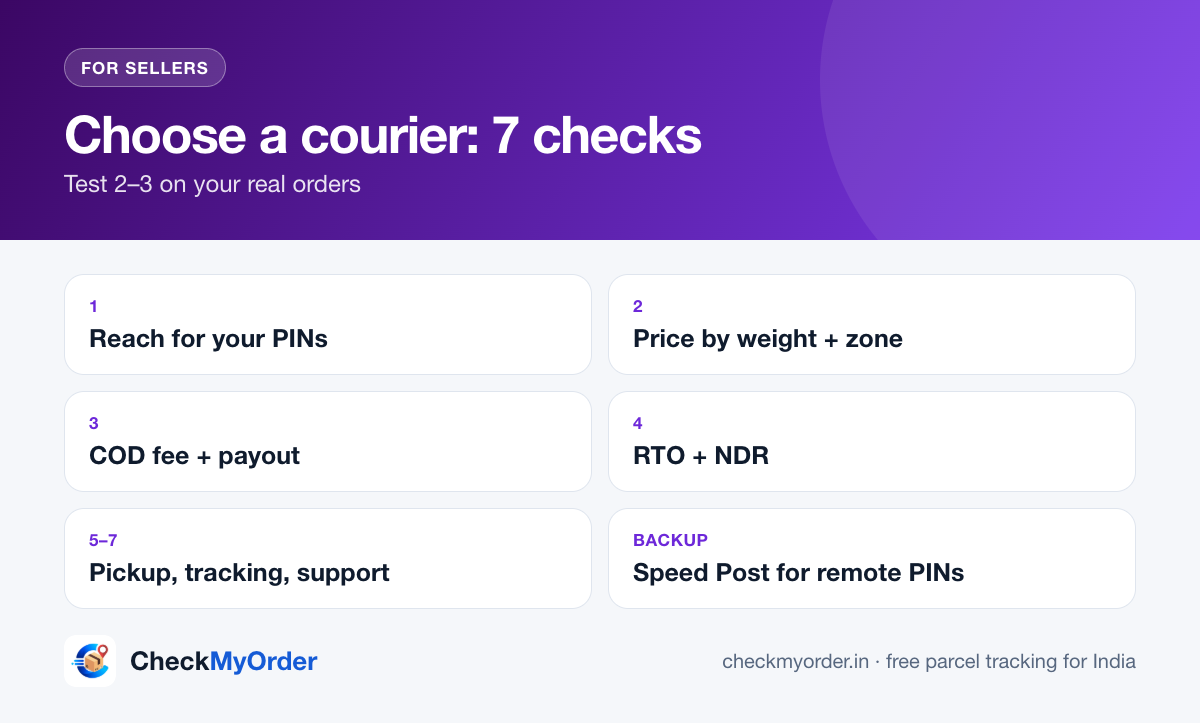
The 7-point checklist
| # | Check | Why it matters |
|---|---|---|
| 1 | Reach for your buyers' PIN codes | Non-serviceable PINs mean lost orders (pincode not serviceable) |
| 2 | Price by weight slab and zone | Volumetric weight often decides the bill (calculator) |
| 3 | COD fee and remittance cycle | Cash flow (COD remittance) |
| 4 | RTO charges and NDR handling | Returns can eat your margin (NDR meaning) |
| 5 | Pickup from your location | Daily pickup saves trips |
| 6 | Tracking your buyers can use | Fewer "where is my order?" messages |
| 7 | Support and disputes | Weight disputes and lost parcels need quick answers |
Match the courier to your business
| Your situation | Often a good fit |
|---|---|
| Few orders, all over India | A shipping aggregator (aggregator vs direct) |
| Many remote or rural buyers | Add India Post Speed Post for those PINs |
| Documents and light parcels | Speed Post's published tariff (charges) |
| High COD share | A courier with good NDR follow-up and fast remittance |
| Heavy or bulky items | Surface or cargo services; compare by weight |
Run a fair test
- Pick 2–3 options and ship similar orders through each for 3–4 weeks.
- Track delivery time, RTO rate, damage, and support response in a simple sheet.
- Keep the winner as your main courier and the second as a backup for its weak PIN codes.
Make tracking easy for buyers
Whichever courier you choose, share the AWB and a tracking link on every order. A free branded tracking page lets buyers track any courier in one place.
A simple scoring sheet
Give each courier 1–5 points on each line after your test period, then multiply by the weight. The highest total wins.
| Factor | Weight | What to measure |
|---|---|---|
| Delivery time | 3 | Average days from pickup to delivery for your top 20 PIN codes |
| RTO rate | 3 | Parcels returned ÷ parcels shipped |
| Cost per order | 2 | Freight + COD fee + GST, at your real chargeable weight |
| Damage and loss | 2 | Damaged or missing parcels per 100 |
| Pickup reliability | 1 | Missed pickups per month (pickup not done?) |
| Support | 1 | Hours to resolve a ticket |
Keep the sheet simple. Ten minutes a week is enough for a small shop.
Work out your real cost per order
The rate card is only the start. For a fair comparison, add up:
- Freight for your chargeable weight (actual or volumetric, whichever is higher). See how courier charges are calculated.
- COD fee, usually a fixed amount or a percentage of the order value, whichever is higher.
- RTO cost: forward and return freight on every parcel that comes back.
- GST on the shipping charges.
- Packaging: a smaller box can drop you into a lower weight slab (right box size).
A courier that looks ₹5 cheaper per parcel can cost more if its RTO rate is higher.
Mistakes small sellers often make
- Choosing on price alone. Late deliveries lead to cancellations and bad reviews.
- Only one courier. Keep a backup for PIN codes your main courier doesn't serve well.
- Not checking weight. Disputes over weight are common; photograph the packed parcel on a scale (weight disputes).
- No follow-up on NDR. A quick WhatsApp to the buyer after a failed attempt saves many COD orders (reduce RTO).
- Hiding the tracking number. Buyers who can track their order message you less.
When to review your choice
Look at your scoring sheet every 2–3 months, and again before big sale seasons such as Diwali and the year-end sales. Volumes, prices and courier performance in your area can change.
Is a shipping aggregator better than signing up with a courier directly?
For small volumes, an aggregator is usually easier: one dashboard, several couriers and no minimum. Once you ship a steady volume with one courier, a direct account may get better rates. See aggregator vs direct courier.
FAQ
Which courier is best for a small business in India?
It depends on your PIN codes, products and COD share. Test a few on real orders.
Should I use Speed Post for my online shop?
For remote PIN codes and light prepaid parcels it's often a strong option; many sellers combine it with a private courier.
Sources

Akshansh Tyagi · Content Writer
Akshansh writes CheckMyOrder's courier and shipping guides: tracking number formats, courier charges, delivery times and shipping advice for small sellers. He researches each topic from official courier and India Post sources.
Reviewed by Rajita Kesarwani, Head of Digital Marketing & Content. Read how we write and check our guides on the About page.