
Fake Courier SMS and 'Parcel Seized' Calls: How to Spot Scams
Fake 'update your address' texts and 'your parcel contains drugs' calls are among India's most common scams. Real vs fake examples, a 10-second check, and where to report.
By CheckMyOrder Editorial TeamPublished Last reviewed 7 min read
Quick answer A courier message is almost certainly a scam if you weren't expecting it and it asks you to tap a link, pay a small fee, share an OTP or UPI PIN, or stay on a call or video call. India Post does not send "update your address" links, and no courier, customs or police officer can put you under "digital arrest". Paste a doubtful message into the free CheckMyOrder SMS scam checker to see its red flags — and if you've lost money, call 1930 straight away.
Check a message in 10 seconds
Got a delivery text you're not sure about?
- Don't tap the link and don't reply.
- Copy the message and paste it into our SMS scam checker — it points out links, fees, deadlines and other warning signs.
- Check the parcel yourself: open the shopping app you ordered from, or paste the tracking number (not the link) into the CheckMyOrder tracker.
What a fake courier SMS looks like
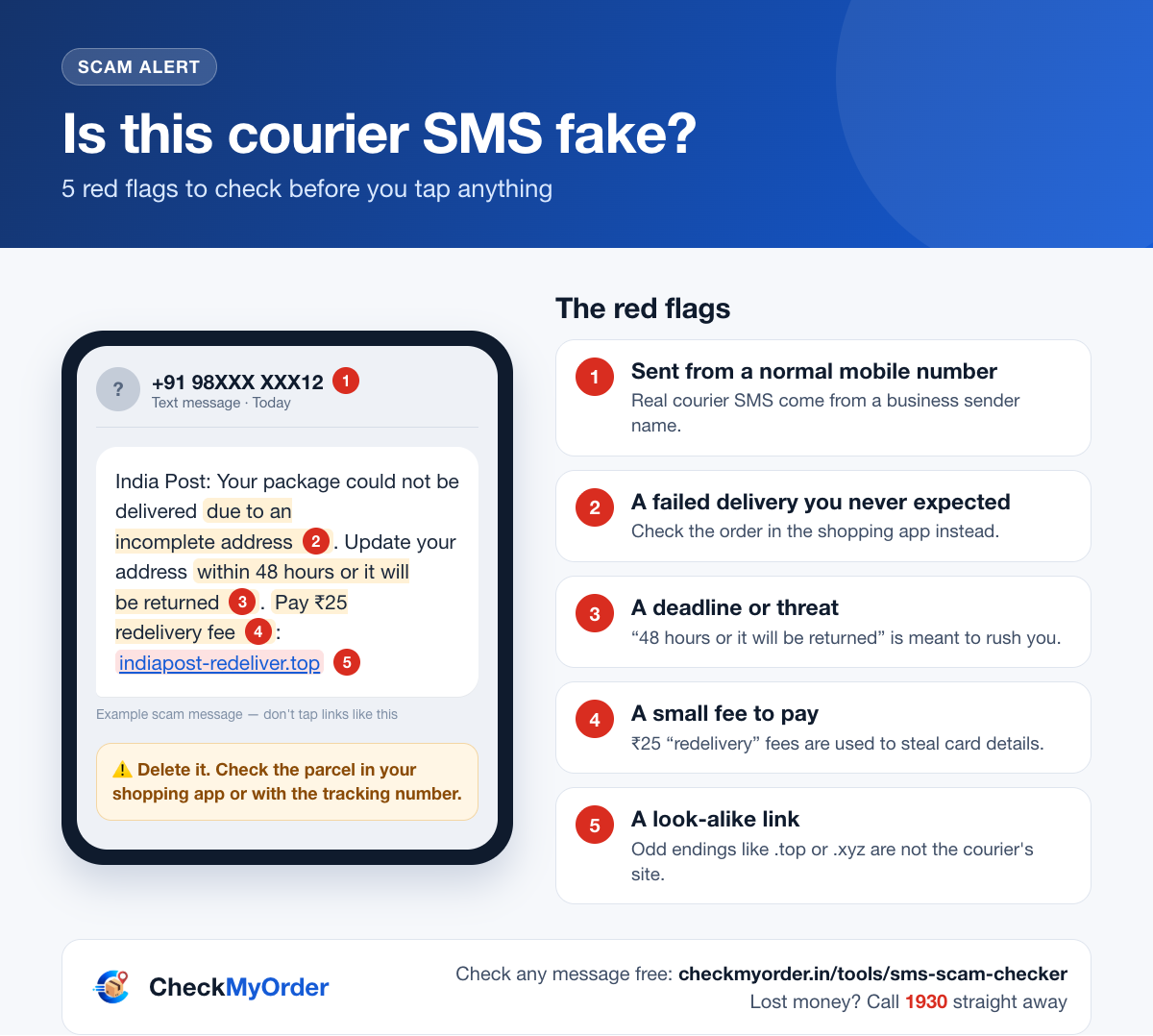
Scam texts copy the tone of real delivery updates. Two typical examples, shortened — don't tap links like these:
Example scam message (English) India Post: Your package has arrived at the warehouse but could not be delivered due to an incomplete address. Update your address within 48 hours or it will be returned: indiapost-redeliver[.]top
Example scam message (Hindi) इंडिया पोस्ट: आपका पार्सल गोदाम में पहुँच गया है, लेकिन पता अधूरा होने से डिलीवरी नहीं हो सकी। 48 घंटे में पता अपडेट करें, वरना पार्सल वापस भेज दिया जाएगा: indiapost-redeliver[.]top
Both use the same tricks: a well-known name, a reason that sounds believable, a deadline, and a link that isn't the courier's real website.
Real delivery message or scam? How to tell
| Check | Genuine message | Scam message |
|---|---|---|
| Were you expecting it? | Yes — you ordered something or someone is sending you a parcel | Often out of the blue |
| Who sent it | A registered business sender name (letters, like XX-ABCDEF) | An ordinary 10-digit mobile number, a foreign number, or WhatsApp |
| The link | The shop's or courier's official website — or no link at all | A look-alike address with extra words or odd endings such as .top, .xyz or .info |
| Money | Only the cash-on-delivery amount you chose when ordering | A small "redelivery", "address update" or "customs" fee |
| OTP | Only at your door, when you receive the parcel | Asked for on a call or a website |
| Tone | A plain update | A deadline, a threat or a "final notice" |
| Apps and secrecy | Nothing to install | "Install AnyDesk / TeamViewer", "don't tell anyone" |
A business sender name alone doesn't prove a message is real — always check the parcel yourself in the shopping app or with the tracking number.
The 5 courier scams doing the rounds in India
1. The fake India Post "update your address" SMS
How it looks: your package reached the warehouse, delivery failed because the address was incomplete, and you must "update your address within 48 hours" through a link — or the parcel goes back.
The truth: the government's PIB Fact Check has clarified that India Post does not send such messages asking you to update details through a link. The links lead to look-alike websites that collect card details, bank logins, Aadhaar data or OTPs, or ask for a small "redelivery fee". To check a real Speed Post article, use its 13-character number on India Post tracking.
2. "Your parcel contains drugs" — and the fake "digital arrest"
How it works:
- A caller — often from a number that looks official — claims to be from FedEx, DTDC or another courier, or from customs.
- They say a parcel booked in your name to another country was seized with drugs, fake passports or credit cards.
- The call is "transferred" to a fake police, NCB or CBI officer, sometimes on a video call from a room dressed up as a police station.
- You're told you are under "digital arrest", must stay on camera, mustn't tell anyone, and must transfer money to "verify" your accounts or "clear your name".
The truth: this is organised fraud. FedEx has publicly said it never asks for personal information by phone or e-mail for shipped goods, and Indian law-enforcement agencies do not arrest or question people over video calls. There is no such thing as a "digital arrest". Hang up, share nothing, and tell your family. (Real FedEx and DTDC shipments can be checked with their tracking numbers.)
3. The small "delivery fee" or "customs fee" link
A message asks for ₹25, ₹49 or a similar small amount to "release" or "reschedule" a parcel. The amount is small so you don't think twice — but the payment page captures your card details or tricks you into approving a much bigger UPI request.
Remember To receive money on UPI you never enter your PIN or approve a request. If a "refund" or "fee" needs your UPI PIN, it's a scam.
4. OTP requests "for delivery"
Some genuine deliveries do use an OTP — India Post introduced OTP-based Speed Post delivery in October 2025, and many shopping apps use delivery OTPs. The rule is simple:
- Share a delivery OTP only face to face, at your door, when you are receiving the parcel.
- Never share an OTP over the phone with someone who says they need it to "confirm", "reschedule" or "cancel" a delivery. Banking, UPI and login OTPs are never shared with anyone.
5. Fake customer-care numbers
Searching "courier customer care number" can surface fake numbers in ads, posts or look-alike websites. The "agent" asks you to install a screen-sharing app or pay a fee. Take support numbers only from the courier's official website — our courier pages link to each courier's official site and tracker.
Expecting a real parcel? Check it safely
- Open the shopping app you ordered from and look at the order's tracking — our shop guides show where each app keeps it.
- Or copy the tracking number (not the link) and check it on the courier's official website or the CheckMyOrder tracker.
- If the courier really needs something from you, the shop's app or the official website will show it.
Tracking number not showing anything? See why a tracking number may not work.
Protect parents and older relatives
Scammers often target people who are less used to online shopping. Five minutes now can save a lot later:
- Teach one rule: no real courier, bank or police officer asks for an OTP, UPI PIN or money on a call.
- Ask them to forward any delivery SMS they're unsure about to you before tapping anything — or to paste it into the scam checker.
- Turn on spam protection or unknown-sender filtering in their phone's messages app.
- Save 1930 in their contacts as "Cyber Crime Helpline".
If you clicked, paid or shared details
- Call 1930 immediately — the national cyber-crime helpline. Reporting quickly gives the best chance of stopping the money.
- Report online at cybercrime.gov.in.
- Call your bank to block cards or UPI, and change passwords for anything you entered.
- Uninstall any screen-sharing app the caller asked you to install.
- Keep evidence: screenshots, phone numbers, links and transaction IDs.
Report suspicious messages even if you didn't lose money
Use Chakshu on the Department of Telecommunications' Sanchar Saathi portal (sancharsaathi.gov.in) to report suspected fraud calls, SMS or WhatsApp messages. It's meant for suspicious communication; if money has already been lost, use 1930 or cybercrime.gov.in.
FAQ
Is the India Post "update your address" SMS real?
No. PIB Fact Check has clarified that India Post does not send messages asking you to update your address through a link. Delete it, or report it on Chakshu.
What is a "digital arrest" scam?
Fraudsters pretending to be courier staff, customs, police, NCB or CBI officers claim a parcel in your name was seized, keep you on a video call and demand money to "clear your name". Indian agencies don't arrest people over video calls — hang up and call 1930 if you've paid anything.
Can a courier ask me for an OTP?
Only at your door, when you are receiving the parcel. Never share an OTP on a phone call or on a website someone sent you.
I paid ₹25 on a fake courier link. What should I do now?
Call 1930 and your bank straight away, block the card or UPI ID you used, and report it at cybercrime.gov.in. Small payments are often used to steal card details for bigger ones later.
Where do I report a fake courier SMS in India?
Report the message on Chakshu (sancharsaathi.gov.in). If you've lost money, call 1930 or file a complaint at cybercrime.gov.in.
Are tracking links in SMS always fake?
No — genuine couriers and shops do send tracking links. The safe habit is to ignore the link and check the tracking number yourself on the official website or a trusted tracker.
Sources
- Govt debunks SMS from India Post asking people to update their address (All India Radio News)(opens in a new tab)
- Fake India Post SMS alert — PIB Fact Check (Goodreturns)(opens in a new tab)
- FedEx says it never requests personal information through phone calls or emails for shipped goods (The Tribune)(opens in a new tab)
- 'Your parcel contains drugs': inside the fake FedEx scam (CyberPeace Foundation)(opens in a new tab)
- Explainer: Government launches 'Chakshu' to report fraud SMS, calls and WhatsApp messages (Factly)(opens in a new tab)
- National Cyber Crime Reporting Portal (helpline 1930), Ministry of Home Affairs(opens in a new tab)
- Sanchar Saathi — Chakshu, Department of Telecommunications(opens in a new tab)